
Purported bin Laden Tape Slams U.S. Role In Pakistan
June 3, 2009
Article Source CNN
(CNN) -- Al Qaeda leader Osama bin Laden purportedly issued another statement Wednesday, saying U.S. policy in Pakistan has generated "new seeds of hatred and revenge against America."
Zeroing in on the conflict in Pakistan's Swat Valley, where Pakistan's troops are taking on Taliban militants, the message asserts that President Obama is proving that he is "walking the same road of his predecessors to build enmity against Muslims and increasing the number of fighters, and establishing more lasting wars."
Al-Jazeera, the Arabic-language TV network that aired the message, said the statement was "a voice recording by bin Laden," and a CNN analysis said the voice does indeed sound like the leader of the terrorist network that attacked the United States on September 11, 2001.
The remarks -- which would be bin Laden's first assessment of Obama's policy -- were believed to have been recorded several weeks ago at the start of a mass civilian exodus because of fighting in northwestern Pakistan.
The speaker cites strikes, destruction and Obama's "order" to Pakistani President Asif Ali Zardari "to prevent the people of Swat from implementing sharia law."
"All this led to the displacement of about a million Muslim elders, women and children from their villages and homes. They became refugees in tents after they were honored in their own homes," the message says.
"This basically means that Obama and his administration put new seeds of hatred and revenge against America. The number of these seeds is the same as the number of those victims and refugees in Swat and the tribal area in northern and southern Waziristan."
And, the message says, "the American people need to prepare to only gain what those seeds bring up." Watch what the speaker says on the tape »
The speaker also says Zardari and Pakistan's military chief, Ashfaq Pervez Kiyani, continue to divert the army's main role from protecting the nation to fighting Islam and its followers. He says the war is also hurting Pakistan's economy, endangering the country's religion and security, and "fulfilling an American, Jewish and Indian plot."
"Most of the Pakistani people reject this unjust war. Zardari did this in response to the ones paying him in the White House -- not 10 percent but multiple folds of that," the message says.
The message points to India's aspirations, saying it is "easy for India to subject the disassembled territories of Pakistan, one after another, for its own benefit, like the case of eastern Pakistan before, or even worse."
"This way, America eases its worry towards Pakistan's nuclear weapons," the message says.
Eastern Pakistan is a reference to Bangladesh, which had been part of Pakistan until it became an independent country in 1971. Pakistan and India have also been at odds over the disputed territory of Kashmir, and pro-bin Laden jihadis have opposed Indian rule there.
Richard Holbrooke, the Obama administration's special envoy to Pakistan and India, said he hadn't listened to the message but commented on what he had heard about it.
"The idea that anyone is responsible for the refugee crisis other than al Qaeda and the Taliban and the other people who have caused such tragedy in western Pakistan is ludicrous," he said. "This entire problem begins with al Qaeda and its associates, and everybody in the world knows that, and it's silly to even respond to such a ludicrous charge."
The message comes as Obama begins his trip to the Middle East, visiting Saudi Arabia on Wednesday and, in Egypt on Thursday, making a major speech to the Muslim world.
Al-Jazeera aired three separate segments totaling just over four minutes from what it said is a new bin Laden audiotape aired over an old still picture of the terrorist leader. The network's anchors took part in describing each of the segments before they ran them.
Since the message was not posted on the radical Islamist Web sites that usually carry statements from al Qaeda, it is believed that this latest message was hand-delivered to the TV network, based in Doha, Qatar.
In other purported bin Laden messages issued in March, he called for Somalia's new president to be overthrown and called Israel's recent offensive in Gaza a "holocaust."
Bin Laden has delivered many messages over the years, but the last video message from him was in early September 2007.
In that video message, he criticized U.S. Democrats for failing to stop the war in Iraq; spoke of the anniversary of the U.S. bombing of Hiroshima and Nagasaki during World War II; the troop surge in Iraq; and world leaders such as French President Nicolas Sarkozy and British Prime Minister Gordon Brown.
On that tape, bin Laden's appearance was artificially changed for the first time. He dyed his beard from grayish white to black, leading analysts to believe that he has switched to sending only audio messages because he is altering his looks and doesn't want people to know what looks like. Analysts also believe that bin Laden hasn't made videos lately because they are more labor-intensive to produce.
There have been gaps between videos from bin Laden, with many audio messages in between, each time prompting analysts to theorize he might be dead. The last two videos of bin Laden himself delivering an address were the 2007 tape and another in 2004. See a timeline of bin Laden messages »
Al Qaeda's second in command issued an audio statement Tuesday saying Obama is not welcome in Egypt.
Ayman al-Zawahiri said relations with the United States cannot be mended so long as the administration maintains its alliance with Israel.
In a message called "Tyrants of Egypt and America's agents welcome Obama" that was posted on Islamist Web sites, al-Zawahiri once again lashed out at the United States. Obama's message to the Muslim world, he said, has already been delivered with his support for "Zionist aggression."
In the 10-minute audio message, al-Zawahiri said Obama had already made himself an enemy of Muslims by sending more soldiers to Afghanistan, ordering bombings in the tribal areas of Pakistan and administering a "bloody campaign against Muslims" in Pakistan's Swat Valley.
CNN Senior Editor for Arab Affairs Octavia Nasr contributed to this report.
The King of The "North" Is Coming!
Moderator: CE Administration
-
Madmary1

- YORWW Bible Academy Graduate (Alumni)

- Posts: 125
- Joined: Thu Jun 02, 2005 6:53 pm
- Location: 2003 Graduate YORWW Bible Academy
- Contact:
Purported bin Laden Tape Slams U.S. Role In Pakistan
Are they Hebrews? I am one also. Are they Israelites? I am one also.
Are they Abraham’s seed? I am also.
(2 Corinthians 11:22)
Are they Abraham’s seed? I am also.
(2 Corinthians 11:22)
-
Ground Zero

- Master Chef On Duty

- Posts: 78
- Joined: Fri May 23, 2008 8:00 am
Re: The King of The "North" Is Coming!
Israel 'Prepared For 30-Day War With Iran'

Iran has the largest and most diverse ballistic missile arsenal in the Middle East - AFP
Article Source
15 August 2012 Last updated at 11:42 ET
Israel's outgoing home front defence minister says an attack on Iran would likely trigger a month-long conflict that would leave 500 Israelis dead.
Matan Vilnai told the Maariv newspaper that the fighting would be "on several fronts", with hundreds of missiles fired at Israeli towns and cities.
Israel was prepared, he said, though strikes on Iran's nuclear facilities had to be co-ordinated with the US.
Meanwhile, a US blogger has published what he says are Israel's attack plans.
Richard Silverstein told the BBC he had been given an internal briefing memo for Israel's eight-member security cabinet, which outlined what the Israeli military would do to prevent Iran developing nuclear weapons.
Tehran insists its nuclear programme is entirely peaceful.
'Israel prepared'
The purported leaked Israeli memo suggests that the military operation would begin with a massive cyber-attack against Iran's infrastructure, followed by a barrage of ballistic missiles launched at its nuclear facilities.
Military command-and-control systems, research and development facilities, and the homes of senior figures in nuclear and missile development would also be targeted.
Only then would manned aircraft be sent in to attack "a short-list of those targets which require further assault".
BBC diplomatic correspondent Jonathan Marcus says it is not possible to verify the authenticity of the document, but the proposed mission would be huge and have potentially far-reaching consequences.
Iran's government and military have made it clear that if it is attacked either by Israel or the US, it will respond in kind, either directly or through proxies.
In his interview with Maariv, Mr Vilnai said Israel had "prepared as never before".
"There is no room for hysteria," said the former general, who is stepping down at the end of August to become Israel's ambassador to China.
He echoed an assessment by Defence Minister Ehud Barak, who said that it was believed that some 500 people in Israel might be killed.
"There might be fewer dead, or more, perhaps... but this is the scenario for which we are preparing, in accordance with the best expert advice."
"The assessments are for a war that will last 30 days on several fronts," he added, alluding to the possibility of attacks by the Iranian-backed Lebanese Shia Islamist movement, Hezbollah, and Palestinian Islamist militants in the Gaza Strip.
Mr Vilnai also declined to comment on US Defence Secretary Leon Panetta's assertion on Tuesday that Washington did not believe Israel had yet made a decision on whether or not to launch a strike on Iran.
"I don't want to be dragged into the debate," he added. "But the United States is our greatest friend and we will always have to co-ordinate such moves with it."
On Tuesday, Israeli Prime Minister Benjamin Netanyahu announced that Mr Vilnai would be succeeded by Avi Dichter, a former head of Israel's internal security agency, Shin Bet.
***
-
Ground Zero
- Master Chef On Duty
- Posts: 78
- Joined: Fri May 23, 2008 8:00 am
Re: The King of The "North" Is Coming!
Al-Qaida's No. 2 In Yemen Killed In Airstrike
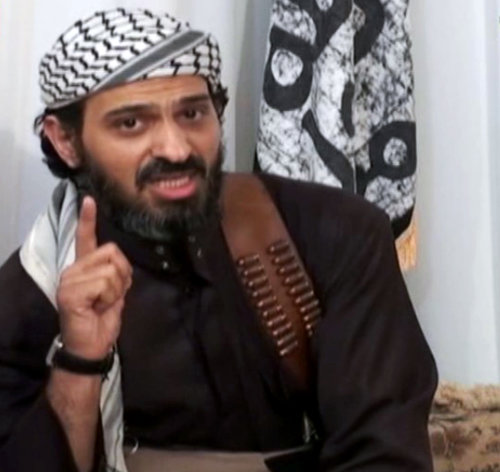
Associated Press/SITE Intelligence Group, File - FILE - In this undated frame grab from video posted on a militant-leaning Web site, and provided by the SITE Intelligence Group, shows Saeed al-Shihri, deputy leader of al-Qaida in the Arabian Peninsula. Yemeni officials say a missile believed to have been fired by a U.S. operated drone on Monday has killed al-Qaida’s No. 2 leader in Yemen along with five others traveling with him in one car. Al-Qaida’s Yemen branch is seen as the world’s most active, planning and carrying out attacks against targets in and outside U.S. territory. (AP Photo/SITE Intelligence Group, File) NO SALES. THE ASSOCIATED PRESS HAS NO WAY OF INDEPENDENTLY VERIFYING THE CONTENT, LOCATION OR DATE OF THIS VIDEO IMAGE
Article Source
Associated Press
September 11, 2012
SANAA, Yemen (AP) — An airstrike killed al-Qaida's No. 2 leader in Yemen along with six others traveling with him in one car on Monday, U.S. and Yemeni officials said, a major breakthrough for U.S.-backed efforts to cripple the group in the impoverished Arab nation.
Saeed al-Shihri, a Saudi national who fought in Afghanistan and spent six years in the U.S. military prison at Guantanamo Bay, was killed by a missile after leaving a house in the southern province of Hadramawt, according to Yemeni military officials. They said the missile was believed to have been fired by a U.S.-operated, unmanned drone aircraft.
Two senior U.S. officials confirmed al-Shihri's death but could not confirm any U.S. involvement in the airstrike. The U.S. doesn't usually comment on such attacks although it has used drones in the past to go after al-Qaida members in Yemen, which is considered a crucial battleground with the terror network.
Yemeni military officials said that a local forensics team had identified al-Shihri's body with the help of U.S. forensics experts on the ground. The U.S. and Yemeni military officials spoke on condition of anonymity because they weren't authorized to release the information to the media.
Late Monday, after speculation surfaced that the attack was carried by a U.S. drone, Yemen's Defense Ministry issued a statement saying al-Shihri and six companions were killed during an operation by Yemeni armed forces in Wadi Hadramawt, but it did not elaborate on how they were killed.
Yemeni military officials said they had believed the United States was behind the operation because their own army does not the capacity to carry out precise aerial attacks and because Yemeni intelligence gathering capabilities on al-Shihri's movements were limited.
A brief Defense Ministry statement sent to Yemeni reporters on their mobile phones earlier in the day only said that an attack had targeted the militants. It did not specify who carried out the attack or when it took place.
Al-Shihri's death is a major blow to al-Qaida's Yemen branch, which is seen as the world's most active, planning and carrying out attacks against targets on and outside U.S. territory. The nation sits on the southern tip of the Arabian Peninsula and is on the doorstep of Saudi Arabia and fellow oil-producing nations of the Gulf and lies on strategic sea routes leading to the Suez Canal.
The group formally known as Al-Qaida in the Arabian Peninsula took advantage of the political vacuum during unrest inspired by the Arab Spring last year to take control of large swaths of land in the south. But the Yemeni military has launched a broad U.S.-backed offensive and driven the militants from several towns.
After leaving Guantanamo in 2007, al-Shihri, who is believed to be in his late 30s, went through Saudi Arabia's famous "rehabilitation" institutes, an indoctrination program that is designed to replace what authorities in Saudi Arabia see as militant ideology with religious moderation.
But he headed south to Yemen upon release and became deputy to Nasser al-Wahishi, the leader of Al-Qaida in the Arabian Peninsula. Al-Wahishi is a Yemeni who once served as Osama bin Laden's personal aide in Afghanistan.
Al-Qaida in Yemen has been linked to several attempted attacks on U.S. targets, including the foiled Christmas Day 2009 bombing of an airliner over Detroit and explosives-laden parcels intercepted aboard cargo flights last year.
Last year, a high-profile U.S. drone strike killed U.S.-born Anwar al-Awlaki, who had been linked to the planning and execution of several attacks targeting U.S. and Western interests, including the attempt to down a Detroit-bound airliner in 2009 and the plot to bomb cargo planes in 2010.
Unlike other al-Qaida branches, the network's militants in Yemen have gone beyond the concept of planting sleeper cells and actively sought to gain a territorial foothold in lawless areas, mainly in the south of Yemen, before they were pushed back by U.S.-backed Yemeni government forces after months of intermittent battles. The fighting has killed hundreds of Yemeni soldiers.
The Yemen-based militants have struck Western targets in the area twice in the past 12 years. In 2000, they bombed the USS Cole destroyer in Aden harbor, killing 17 sailors. Two years later, they struck a French oil tanker, also off Yemen.
U.S. drone strikes have intensified in Yemen in recent months, killing several key al-Qaida operatives, including Samir Khan, an al-Qaida propagandist who was killed in a drone strike last year.
***
-
Ground Zero
- Master Chef On Duty
- Posts: 78
- Joined: Fri May 23, 2008 8:00 am
Re: The King of The "North" Is Coming!
In Sudan, Protesters Attack German and British Embassies

Article Source
The Atlantic Wire – 34 mins ago
Germany's embassy in Sudan became the latest target of Muslim outrage against the West on Friday, as thousands of protesters stormed the grounds and set it on fire while others attacked the British embassy there. The details are still trickling in, but according to Der Spiegel about 5,000 protesters penetrated the embassy's grounds and tore down the German flag, raising an Islamist banner and setting the building aflame. The protesters at the British embassy next door are still outside the walls, according to the Associated Press. Fortunately, tweets CNN's RA Greene, the German embassy is likely empty because it's a Friday. Al Jazeera's main Arabic channel is carrying live coverage showing smoke and flames. The New York Times noted that protests were expected to flare up with a vengeance on Friday following Muslim prayers. Meanwhile, in Tripoli, Lebanon, protesters set fire to a KFC (that image to the left) as Pope Benedict arrived to call for peace.

***
-
Ground Zero
- Master Chef On Duty
- Posts: 78
- Joined: Fri May 23, 2008 8:00 am
Re: The King of The "North" Is Coming!
Afghan Militants Say Deadly Blast Was Revenge For Film
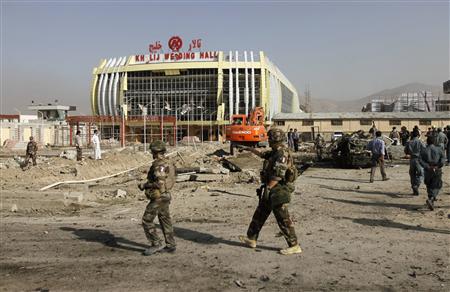
Nato soldiers arrive at the site of a suicide bomb attack in Kabul September 18, 2012. Afghan insurgent group Hezb-e-Islami claimed responsibility on Tuesday for the suicide bomb attack on a minivan carrying foreign workers that killed 12 people saying it was retaliation for a film mocking the Prophet Mohammad. REUTERS/Mohammad Ismail
Article Source
Reuters – 5 hrs ago
KABUL (Reuters) - Afghan militants claimed responsibility on Tuesday for a suicide bomb attack on a minivan carrying foreign workers that killed 12 people saying it was retaliation for a film mocking the Prophet Mohammad.
A short film made with private funds in the United States and posted on the Internet has ignited days of demonstrations in the Arab world, Africa, Asia and in some Western countries.
In a torrent of violence blamed on the film last week, the U.S. ambassador to Libya and three other Americans were killed in an attack in Benghazi and U.S. and other foreign embassies were stormed in cities in Asia, Africa and the Middle East by furious Muslims. At least nine other people were killed.
On Tuesday, a suicide bomber blew up a minivan near the airport in the Afghan capital and a spokesman for the Hezb-e-Islami insurgent group claimed responsibility.
"A woman wearing a suicide vest blew herself up in response to the anti-Islam video," said militant spokesman Zubair Sediqqi. Police said the woman may have been driving a Toyota Corolla car rigged with explosives, which she triggered.
But the claim will raise fears that anger over the film will feed into deteriorating security as the United States and other Western countries try to protect their forces from a rash of so-called insider attacks by Afghan colleagues.
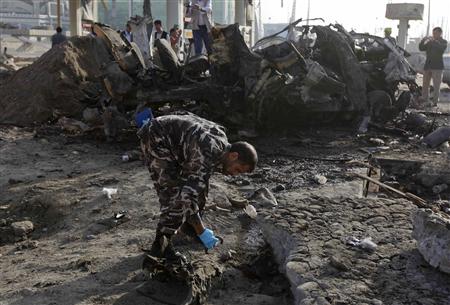
An Afghan security officer investigates at the site of a suicide attack in Kabul September 18, 2012. A suicide bomber blew up a mini-bus carrying foreign and local contract workers near Kabul airport in Afghanistan on Tuesday, with at least nine bodies lying near the wreckage, a Reuters witness at the scene said. REUTERS/Omar Sobhani
The protesters in Kabul and several other Asian cities have vented their fury over the film at the United States, blaming it for what they see as an attack on Islam.
The outcry saddles U.S. President Barack Obama with an unexpected foreign policy headache as he campaigns for re-election in November, even though his administration has condemned the film as reprehensible and disgusting.
In response to the violence in Benghazi and elsewhere last week, the United States has sent ships, extra troops and special forces to protect U.S. interests and citizens in the Middle East, while a number of its embassies have evacuated staff and are on high alert for trouble.
Despite Obama's efforts early in his tenure to improve relations with the Arab and Muslim world, the violence adds to a host of problems including the continued U.S. military involvement in Afghanistan, Iran's nuclear program, the Syrian civil war and the fall-out from the Arab Spring revolts.
PROTESTS, BANS
The renewed protests on Monday dashed any hopes that the furor over the film might fade despite an appeal over the weekend from the senior cleric in Saudi Arabia, home to Islam's holiest shrines, for calm.
Afghan police said among the 12 dead in the Kabul bomb attack were eight Russians and South Africans, mostly working for a foreign air charter company named ACS Ltd.
It followed a bloody weekend during which six members of Afghanistan's NATO-led alliance, including four Americans, were killed in suspected insider attacks carried out by Afghans turning on their allies.
Protesters also took to the streets in Pakistan and Indonesia on Monday and thousands also marched in Beirut, where a Hezbollah leader accused U.S. spy agencies of being behind events that have unleashed a wave of anti-Western sentiment in the Muslim and Arab world.
Authorities in Bangladesh have blocked the YouTube website indefinitely to stop people seeing the video. Pakistan and Afghanistan have also blocked the site.
Iran has condemned the film as offensive and vowed to pursue those responsible for making it. Iranian officials have demanded the United States apologize to Muslims, saying the film is only the latest in a series of Western insults aimed at Islam's holy figures.
The identity of those directly responsible for the film remains unclear. Clips posted online since July have been attributed to a man named Sam Bacile, which two people connected with the film have said was probably an alias.
Nakoula Basseley Nakoula, 55, a Coptic Christian widely linked to the film in media reports, was questioned in California on Saturday by U.S. authorities investigating possible violations of his probation for a bank fraud conviction.
***
-
Ground Zero
- Master Chef On Duty
- Posts: 78
- Joined: Fri May 23, 2008 8:00 am
Re: The King of The "North" Is Coming!
Turkey's Parliament Authorises Military Action in Syria
BBC NewsArticle Source
4 October 2012
BBC's Peter Biles: "Turkey has strongly condemned the action by Syria"
Turkey's parliament has authorised troops to launch cross-border action against Syria, following Syria's deadly shelling of a Turkish town.
The bill, passed by 320 to 129, also permits strikes against Syrian targets.
But Deputy Prime Minister Besir Atalay insisted this was a deterrent and not a mandate for war.
Turkey has been firing at targets inside Syria since Wednesday's shelling of the town of Akcakale, which killed two women and three children.
Ankara's military response marks the first time it has fired into Syria during the 18-month-long unrest there.
Several Syrian troops were killed by Turkish fire, a UK-based Syrian activist group said. Damascus has not confirmed any casualties.
Apology
The Turkish parliament passed the bill in a closed-doors emergency session.
It permits military action, if required by the government, for the period of one year.
However, Mr Atalay insisted the priority was to act in co-ordination with international bodies.
He told Turkish television: "This mandate is not a war mandate but it is in our hands to be used when need be in order to protect Turkey's own interests."
He said Syria had accepted responsibility for the deaths.
"The Syrian side has admitted what it did and apologised," Mr Atalay said.
Zeliha Timucin, her three daughters and her sister died in Akcakale when a shell fell in their courtyard as they prepared the evening meal.
They were buried in a local cemetery on Thursday.
Turkey had called for the UN Security Council to meet and take "necessary action" to stop Syrian "aggression".
However, Mr Atalay said on Thursday that UN and Syrian representatives had spoken on Wednesday evening.
He said: "Syria... said nothing like this will happen again. That's good. The UN mediated and spoke to Syria."
Nato has held an urgent meeting to support Turkey, demanding "the immediate cessation of such aggressive acts against an ally".
The US, the UK, France and the European Union have already condemned Syria's actions.
Akcakale

- Akcakale is a district of southern Sanliurfa province, close to the border with Syria
- The last published census in 2000 shows its population stood at just over 77,000
- It is just under 50km (31 miles) from the Syrian border town of Tall al-Abyad and about 240 km (150 miles) from Aleppo
- The area surrounding the town is known for its archaeological excavations
The BBC's Jim Muir in Beirut says neither Turkey nor Syria wants this to develop into a war. He says there is no appetite in Nato or the West for military conflict and that it is noticeable how conciliatory Syria has been since the news of the shelling broke.
Many social media users in Turkey have been reacting strongly against the possibility of war with Syria.
Hashtags such as #notowar drew a lot of attention.
One user, coymak, tweeted: "There is no victory in war, only victory is the happiness in the eye of the children when it is ended!"
There were many tweets referring to the call for an anti-war rally in central Istanbul on Thursday evening.
In Syria itself as many as 21 members of Syria's elite Republican Guards have been killed in an explosion and firefight in the Qudsaya district of Damascus, the UK-based Syrian Observatory for Human Rights (SOHR) told the BBC.
The SOHR is one of the most prominent organisations documenting and reporting incidents and casualties in the Syrian conflict. The group says its reports are impartial, though its information cannot be independently verified.
***
-
Apollyon (Revelation 9:11)

- Happy Restaurant Owner-Business Is Good!

- Posts: 175
- Joined: Sat Jun 18, 2005 7:44 am
- Location: Founder YORWW Bible Institute & Training Center
- Contact:
Re: The King of The "North" Is Coming!
U.S. Cruise Missile Syria Attack In Response To 4,000 Chemical Weapons Victims

Source of Article
August 25, 2013
A U.S. cruise missile Syria attack in response to Syria’s 4,000 chemical weapons victims is waiting for President Obama’s green light. “Defense Secretary Chuck Hagel indicated that U.S. military forces are positioned in the Mediterranean and ready to act if President Barack Obama orders a strike on Syria amid allegations that the Syrian government used chemical weapons in an attack this week,” reported Bloomberg on Aug. 24, 2013.
After the Aug. 21, 2013, chemical weapons attack on a Damascus suburb that killed 1,300 people, many of them children, President Obama is under increased pressure to intervene in Syria.
According to Médecins Sans Frontières (MSF), the international organization Doctors Without Borders, 3,600 patients are in hospitals with symptoms of poisonous gases. In Ghouta, a suburb of Damascus, 322 deaths have been reported -- including 54 children, 82 women, and dozens of rebels.
Many of the poisonous gas victims were attacked while sleeping. “The attackers used rockets to release fatal fumes over the suburb in the early hours of yesterday morning as people slept in their homes.”
Despite the publication of pictures of the dead in mass graves and uploaded YouTube videos, the international community is hesitant to intervene in Syria because the Syrian government, especially President Bashar al-Assad, is denying of having any involvement in the chemical weapons attack.
While China, Russia, and Iran are emphasizing that further evidence is needed, Britain and the United States have called for an emergency session of the United Nations Security Council to discuss military options available to the West.
According to a report coming from Europe, French foreign minister Laurent Fabius said that all indications show the Syrian government was behind the "chemical massacre".
"All the information at our disposal converges to indicate that there was a chemical massacre near Damascus and that the Bashar regime is responsible. France has previously stated that any confirmed use of chemical weapons would provide grounds for military intervention.”
According to a U.S. official, the United States has now four destroyers equipped with Tomahawk cruise missiles in the Mediterranean Sea: the USS Gravely, the USS Barry, the USS Mahan and the USS Ramage.
Judging from Defense Secretary Chuck Hagel’s statement that “the international community is moving swiftly in getting facts on what did happen and getting the intelligence right and all the other factors that go into a decision will be made swiftly and should be made swiftly,” -- a U.S. cruise missile Syria attack will happen without much notice to the public and will occur “swiftly.”
*** End of Article
Source of Article
August 25, 2013
A U.S. cruise missile Syria attack in response to Syria’s 4,000 chemical weapons victims is waiting for President Obama’s green light. “Defense Secretary Chuck Hagel indicated that U.S. military forces are positioned in the Mediterranean and ready to act if President Barack Obama orders a strike on Syria amid allegations that the Syrian government used chemical weapons in an attack this week,” reported Bloomberg on Aug. 24, 2013.
After the Aug. 21, 2013, chemical weapons attack on a Damascus suburb that killed 1,300 people, many of them children, President Obama is under increased pressure to intervene in Syria.
According to Médecins Sans Frontières (MSF), the international organization Doctors Without Borders, 3,600 patients are in hospitals with symptoms of poisonous gases. In Ghouta, a suburb of Damascus, 322 deaths have been reported -- including 54 children, 82 women, and dozens of rebels.
Many of the poisonous gas victims were attacked while sleeping. “The attackers used rockets to release fatal fumes over the suburb in the early hours of yesterday morning as people slept in their homes.”
Despite the publication of pictures of the dead in mass graves and uploaded YouTube videos, the international community is hesitant to intervene in Syria because the Syrian government, especially President Bashar al-Assad, is denying of having any involvement in the chemical weapons attack.
While China, Russia, and Iran are emphasizing that further evidence is needed, Britain and the United States have called for an emergency session of the United Nations Security Council to discuss military options available to the West.
According to a report coming from Europe, French foreign minister Laurent Fabius said that all indications show the Syrian government was behind the "chemical massacre".
"All the information at our disposal converges to indicate that there was a chemical massacre near Damascus and that the Bashar regime is responsible. France has previously stated that any confirmed use of chemical weapons would provide grounds for military intervention.”
According to a U.S. official, the United States has now four destroyers equipped with Tomahawk cruise missiles in the Mediterranean Sea: the USS Gravely, the USS Barry, the USS Mahan and the USS Ramage.
Judging from Defense Secretary Chuck Hagel’s statement that “the international community is moving swiftly in getting facts on what did happen and getting the intelligence right and all the other factors that go into a decision will be made swiftly and should be made swiftly,” -- a U.S. cruise missile Syria attack will happen without much notice to the public and will occur “swiftly.”
*** End of Article
"....save both yourself and those who listen to you." -- 1 Timothy 4:16
Re: The King of The "North" Is Coming!
AL-QAIDA NUKES ALREADY IN U.S.
Terrorists, bombs smuggled across Mexico border by MS-13 gangsters
Article SourceTerrorists, bombs smuggled across Mexico border by MS-13 gangsters
Published: 07/11/2005 at 12:22 PM
WASHINGTON – As London recovers from the latest deadly al-Qaida attack that killed at least 50, top U.S. government officials are contemplating what they consider to be an inevitable and much bigger assault on America – one likely to kill millions, destroy the economy and fundamentally alter the course of history, reports Joseph Farah’s G2 Bulletin.
According to captured al-Qaida leaders and documents, the plan is called the “American Hiroshima” and involves the multiple detonation of nuclear weapons already smuggled into the U.S. over the Mexican border with the help of the MS-13 street gang and other organized crime groups.
Al-Qaida has obtained at least 40 nuclear weapons from the former Soviet Union – including suitcase nukes, nuclear mines, artillery shells and even some missile warheads. In addition, documents captured in Afghanistan show al-Qaida had plans to assemble its own nuclear weapons with fissile material it purchased on the black market.
In addition to detonating its own nuclear weapons already planted in the U.S., military sources also say there is evidence to suggest al-Qaida is paying former Russian special forces Spetznaz to assist the terrorist group in locating nuclear weapons formerly concealed inside the U.S. by the Soviet Union during the Cold War. Osama bin Laden’s group is also paying nuclear scientists from Russia and Pakistan to maintain its existing nuclear arsenal and assemble additional weapons with the materials it has invested hundreds of millions in procuring over a period of 10 years.
The plans for the devastating nuclear attack on the U.S. have been under development for more than a decade. It is designed as a final deadly blow of defeat to the U.S., which is seen by al-Qaida and its allies as “the Great Satan.”
At least half the nuclear weapons in the al-Qaida arsenal were obtained for cash from the Chechen terrorist allies.
But the most disturbing news is that high level U.S. officials now believe at least some of those weapons have been smuggled into the U.S. for use in the near future in major cities as part of this “American Hiroshima” plan, according to an upcoming book, “The Al Qaeda Connection: International Terrorism, Organized Crime and the Coming Apocalypse,” by Paul L. Williams, a former FBI consultant.
According to Williams, former CIA Director George Tenet informed President Bush one month after the Sept. 11, 2001, attacks that at least two suitcase nukes had reached al-Qaida operatives in the U.S.
“Each suitcase weighed between 50 and 80 kilograms (approximately 110 to 176 pounds) and contained enough fissionable plutonium and uranium to produce an explosive yield in excess of two kilotons,” wrote Williams. “One suitcase bore the serial number 9999 and the Russian manufacturing date of 1988. The design of the weapons, Tenet told the president, is simple. The plutonium and uranium are kept in separate compartments that are linked to a triggering mechanism that can be activated by a clock or a call from the cell phone.”
According to the author, the news sent Bush “through the roof,” prompting him to order his national security team to give nuclear terrorism priority over every other threat to America.
However, it is worth noting that Bush failed to translate this policy into securing the U.S.-Mexico border through which the nuclear weapons and al-Qaida operatives are believed to have passed with the help of the MS-13 smugglers. He did, however, order the building of underground bunkers away from major metropolitan areas for use by federal government managers following an attack.
Bin Laden, according to Williams, has nearly unlimited funds to spend on his nuclear terrorism plan because he has remained in control of the Afghanistan-produced heroin industry. Poppy production has greatly increased even while U.S. troops are occupying the country, he writes. Al-Qaida has developed close relations with the Albanian Mafia, which assists in the smuggling and sale of heroin throughout Europe and the U.S.
Some of that money is used to pay off the notorious MS-13 street gang between $30,000 and $50,000 for each sleeper agent smuggled into the U.S. from Mexico. The sleepers are also provided with phony identification, most often bogus matricula consular ID cards indistinguishable from Mexico’s official ID, now accepted in the U.S. to open bank accounts and obtain driver’s licenses.
The Bush administration’s unwillingness to secure the U.S.-Mexico border has puzzled and dismayed a growing number of activists and ordinary citizens who see it as the No. 1 security threat to the nation. The Minuteman organization is planning a major mobilization of thousands of Americans this fall designed to shut down the entire 2,000-mile border as it did in April with a 23-mile stretch in Arizona.
According to Williams’ sources, thousands of al-Qaida sleeper agents have now been forward deployed into the U.S. to carry out their individual roles in the coming “American Hiroshima” plan.
Bin Laden’s goal, according to the book, is to kill at least 4 million Americans, 2 million of whom must be children. Only then, bin Laden has said, would the crimes committed by America on the Arab and Muslim world be avenged.
There is virtually no doubt among intelligence analysts al-Qaida has obtained fully assembled nuclear weapons, according to Williams. The only question is how many. Estimates range between a dozen and 70. The breathtaking news is that an undetermined number of these weapons, including suitcase bombs, mines and crude tactical nuclear weapons, have already been smuggled into the U.S. – at least some across the U.S.-Mexico border.
The future plan, according to captured al-Qaida agents and documents, suggests the attacks will take place simultaneously in major cities throughout the country – including New York, Boston, Washington, Las Vegas, Miami, Chicago and Los Angeles.
In response to the G2 Bulletin revelations, Chris Simcox, founder of the Minuteman Civil Defense Corps, a citizen action group demanding the U.S. government take control of its borders, said an immediate military presence on the borders is now imperative “to stop the overwhelming influx of unidentified, potentially hostile and seditious persons coming across at an alarming rate.”
“Terrorists have carte blanche to carry practically anything they want across our national line at this time,” he said. “As ordinary citizens have warned this government for years, the only surprising part about the new information reported here is that nothing apocalyptic from Mexican-border weapons trafficking has yet happened. Terrorism has reared its ugly head in London again these past few days, and as we know all too well we are not immune in this country. At this point, the next attempt to attack America at home is just a matter of ‘when,’ not ‘if.’ And our unsecured borders have surely contributed to this threat – yet our government officials continue to fiddle while our nation’s margin of security and safety burns away. The president and Congress had better wake up before they have to answer for another devastating terrorist incursion on our own soil.”
***
Re: The King of The "North" Is Coming!
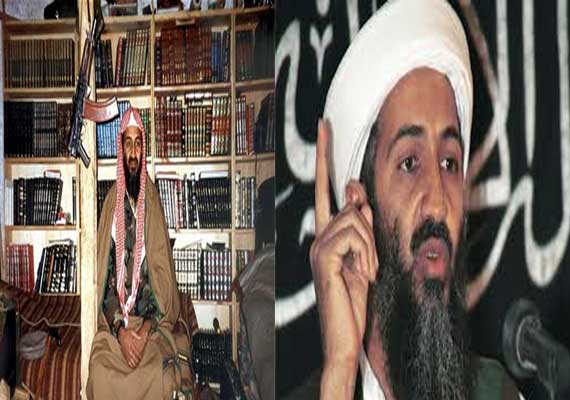
Osama Bin Laden 'Alive and Recruiting',
Claims Terror Expert
Claims Terror Expert
Article Source
Updated 11 May 2014, 07:06:21
New Delhi: If claims by an al-Qaeda expert are to be believed, world's most wanted man Osama Bin Laden is still alive and recruiting fresh support in Britain and Europe.
Dr Rohan Gunaratna, a world authority on Islamic terrorism, said that the Saudi-born militant was the author of a defiant message posted last week on an al Qaida website, reports The Daily Mail.

It stated: 'We don't care about Western public opinion because it is for the Western people and in any case backs Western governments.
'Therefore it should not be a matter of concern for us whether western public opinion turns against us or not. We did this operation not for human kind but for Allah.'

Dr Gunaratna said that the message, which featured prominently on the website, had bin Laden's 'signature all over it' but did not state that he was its author because 'it is important for al Qaeda to maintain ambiguity about whether he is alive or dead'.
He went on: 'It's in the interests of the Jihad campaign to keep people guessing about whether Osama bin Laden is still living.

He said the statement was a response to a wave of criticism from Muslims all over the world after the broadcast of a video last month by a Gulf TV station showing bin Laden, his deputy and a man identified as one of the 11 September hijackers.
In one excerpt of the video - broadcast by Al Jazeera on April 15 - a man identified as Ahmed Ibrahim Al Haznawi speaks to the camera.

Dr Gunaratna said that prior to the release of the video there was still some doubt in the minds of Muslims about whether al-Qaeda were definitely responsible for the US attacks.
But the broadcast finally erased that doubt provoking criticism from Muslims everywhere concerned that the extremist group was giving Islam a bad name, said Dr Gunaratna.
He said he believed that Western military leaders have privately accepted that the war in Afghanistan, where the Royal Marines are busy combing mountain lairs used by al-Qaeda fighters, was 'far from over'.
***
Re: The King of The "North" Is Coming!
Syrian Elections: Democratic Reform Undermines US-NATO Agenda
By Prof. Tim AndersonGlobal Research, May 19, 2014
Region: Middle East & North Africa
Theme: US NATO War Agenda
In-depth Report: SYRIA: NATO'S NEXT WAR?
Article Source
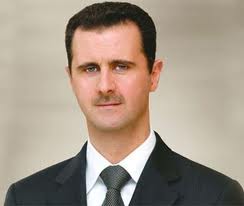
ASSAD
However the country’s first competitive presidential elections in recent times threatens to add a ‘normality’ to Syria’s previously one party system, a normality the western powers are desperate to avoid.
Hence Washington’s decision to deliver new weapons systems (like anti-tank missiles) to the al Qaeda-style ‘rebel’ groups, even when it has become clear that the Government and national army are prevailing in most parts of the country.
Let’s be clear about these elections, it is not some simple political choice to hold them at this time. They are required by Syria’s constitution, before the end of President Bashar’s term in July. To ignore this requirement, to suspend the constitution, would have deepened rather than help resolve the crisis.
Of course, a major test will be voter turn-out. Prospects for participation have improved strongly with the recent elimination of armed groups from Homs, Syria’s third largest city. A turn-out rate that exceeded that of 2012 would be a good sign for Syria’s democratic process.
Turnout in the 2012 Assembly and constitutional reform votes was estimated at a little over 51%; not high, but higher than the 2010 US Congressional elections participation rate of 41.6%. Remember, at that time, the Muslim Brotherhood-backed ‘Free Syrian Army’ was threatening and delivering death to those who participated in the voting.
No doubt the FSA’s al Qaeda-style successors are making the same threats now. But Syria’s army has backed them into a few corners. The last thing these sectarian fanatics want is any sort of democracy.
It is precisely because of the constitutional changes in 2012 that Syrian voters now have presidential choices, apart from the incumbent. The other candidates are Maher Hajjar, an independent communist from Aleppo, and businessman Hassan al-Nouri.
All three candidates have accepted a set of ‘national principles’ which include support for the Syrian Arab Army as ‘the protector of Syria against any foreign aggression and internal sabotage’. There is no Washington or Paris-backed candidate calling for an Islamic state; such sectarianism remains banned under the constitution.
However neither Hajjar nor al-Nouri can be dismissed as simple patsies for President Bashar. Under current rules each had to secure the support of at least 35 MPs in the current 200+ parliament; and MPs can only back one candidate. That means there is substantial electoral support for the two non-Ba’ath Party candidates, albeit support for those who back a ‘secular’ or pluralist nation.
Getting over the 35-MP hurdle, the new candidates still face the fact that President Bashar counts not only on the backing of the 60% of MPs who belong to the Ba’ath Party. The Syrian Social National Party (SSNP) and the Communist Party have also thrown their weight behind him. Bashar is increasingly seen as a symbol of resistance and national unity, and essential to winning the war.
In actual policy terms some more conventional themes have emerged. Hajjar, as the left candidate, remains a pan-Arabist and backs redistributive policies alongside huge capital works, to address unemployment. He also aims to attack corruption, probably the key complaint of the wider reform movement in recent years.
For his part, Al-Nouri, as the right-wing candidate, stresses a type of ‘modernization’ called the ‘smart free economy’, with emphasis on public-private partnerships. Indeed many of the major investments in Syria in recent years, like the large tourist hotels, have been joint venture operations. The small business sector, of course, is extensive.
As a candidate, Bashar al Assad sits at the centre left of this new configuration. His government has maintained free health and education, throughout economic hard times and war and, if anything, the conflict has deepened Bashar’s commitment to state investment. He was always seen as a reformer and moderniser but now, importantly, he is seen as a ‘rock’ which has successfully defended Syria against the western-backed sectarian Islamists. That is what will clinch the vote for him. He seems likely to get a higher vote than his Ba’ath party colleagues did in the Assembly elections of 2012.
By failing to engage with the reform process at the Geneva 2 talks in January (when there still existed the possibility of constitutional change) the exiled, Muslim Brotherhood-led ‘opposition’ have effectively shot themselves in the collective foot.
Rather like the pro-coup opposition in Venezuela, ten years ago, they rejected ‘normal’ politics in the hope that backing from the big powers would deliver them government by violence and deception. They rejected dialogue and reform for attacks on schools, hospitals, and ordinary people, blaming the government for their own sectarian massacres. That strategy backfired and they have now excluded themselves from Syrian political life for many years.
Syria’s democratic reform process is advancing, despite the ongoing terrorist war, and it threatens to derail the western ‘regime change’ agenda. The al Qaeda-style groups have served to unite the reform movement with pro-government forces. For these reasons, Syria’s June 3 vote will be a patriotic election.
***
Re: The King of The "North" Is Coming!
Syrian al Qaeda Reach Foothills of Israeli-held Golan
Reuters May 22, 2014 2:21 AM
Article Source
By Suleiman Al-Khalidi
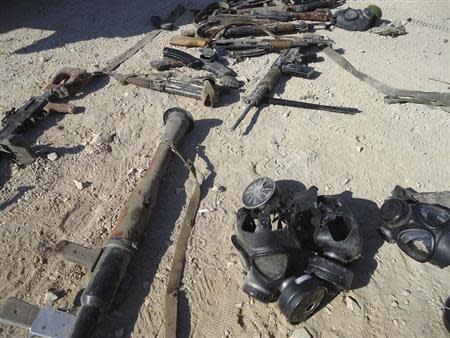
Weapons are seen in the sand near Adra, east of Damascus,
in this handout photograph distributed by Syria's national news agency SANA
August 7, 2013. REUTERS/SANA/Handout
One of the men, a leader of al Qaeda's Nusra Front, compares their battlefield - a lush agricultural region where dead soldiers lie on the ground near a charred Soviet-era tank - with the struggle their comrades waged years ago in Afghanistan.
"This view reminds us of the lion of the mujahideen, Osama bin Laden, on the mountains of Tora Bora," he can be heard saying in a video posted by the group, which shows the fighters in sight of Israeli jeeps patrolling the fortified frontier.
Last month's capture of the post was followed days later by the seizure of the Syrian army's 61 Infantry Brigade base near the town of Nawa, one of the biggest rebel gains in the south during the three years of Syria's war.
The advances are important not just because they expand rebel control close to the Israeli-occupied Golan Heights and the Jordanian border, but because President Bashar al-Assad's power base in Damascus lies just 40 miles to the north.
They have brought heavy retaliation from Assad's forces, including aerial bombardment. The army has also sent elite troop reinforcements to the south in recent days after rebels pulled out of Homs city, relieving pressure on the army there.
The reinforcements reflect Assad's determination, on the eve of a June 3 presidential election likely to extend his power for another seven years, not to lose control of the towns of Nawa and Quneitra in the Golan foothills.
Rebels last year briefly took the Quneitra border crossing with Israel and now control many rural villages in the area.
"The regime has rung alarm bells, fearing that the fall of Nawa and Quneitra could open an axis towards Damascus," said Brigadier General Assad Zoubi, who headed an air force academy before defecting in early 2012.
AL QAEDA POWER GROWS
The southern front's potential as a launchpad for an offensive against the capital means it could ultimately pose the main challenge to Assad.
"It's a much shorter distance than that required for a push to Damascus from the rebels' northern strongholds. The southern front, contrary to all previous expectations, may ultimately be the crucial one," said Ehud Yaari, a fellow at the Washington Institute, a leading U.S. think-tank.
"Coalitions of rebels are proving effective against regime outposts," said Yaari, adding Syrian army units in the south were thinly spread and often isolated.
Recent rebel advances have been mainly achieved by the Nusra Front together with other Islamist brigades and rebels fighting under the broad umbrella of the Free Syrian Army.
In all, Western intelligence sources estimate around 60 insurgent groups are operating in southern Syria. In contrast to the deadly internecine rebel fighting further north, so far they have coordinated well in battle.
Echoing the trend in the north, however, radical groups such as Nusra, Muthana and Ahrar al-Sham have grown in influence, eroding the dominance of larger brigades backed by Saudi Arabia.
The weakness of those brigades was further exposed when they failed to respond to Nusra's abduction of Colonel Ahmad Neamah, a critic of radical Islamists who leads the Western- and Saudi-backed military council which has around 20,000 rebels under its nominal authority.
The trial earlier this month of Neamah in a Nusra court, where he was videoed confessing to holding back weapons from rebels to suit foreign powers who wanted to prolong the conflict, has further discredited the moderate rebels' cause.
Rebels in Deraa, the cradle of the 2011 uprising against Assad, have long complained that unlike their comrades in the north, they have been choked of significant arms, with both the West and Jordan wary of arming insurgents so close to Israel.
SAUDI CONTAINMENT POLICY
From a covert operations room in the Jordanian capital Amman, intelligence officers from countries including the United States, Jordan, Saudi Arabia and the United Arab Emirates assess arms requests by the rebels.
They have ensured some light arms and ammunition cross the border - enough only to make tactical gains every once in a while - rebels in contact with the operations room say.
They say Saudi Arabia, the main backer, is now focusing less on a military challenge to Assad and more on financing groups such as the Yarmouk Brigade, Ahfad al-Rasoul Brigades and al-Omari Brigade to counter the future spread of al Qaeda.
"They are supporting groups that will one day stand up to the extremist radical groups and now want to disrupt the road to Damascus so that the battle is prolonged," said one Islamist rebel leader, who asked not to be identified.
Riyadh's deeper concern stems from the impact an al Qaeda enclave so close to home could have on thousands of young disaffected Saudis, according to Jordanian security sources. At its closest point, Saudi Arabia is separated from southern Syria by just 100 km (60 miles) of Jordanian desert.
Moderate rebels say they are losing ground because of Western reluctance to provide anti-aircraft weapons that could curb Assad's devastating air strikes.
In contrast, financial support from private Salafi funders mainly in Kuwait, Saudi Arabia and Qatar has enabled Nusra and hardline Islamist brigades to recruit more young men and tap into anger at perceived betrayal by the West and regional powers.
FROM BATTLEFIELD TO COURTS
Now nearly 2,000 Nusra Front fighters operate in the area with organizational skills that far outweigh those of their more secular-minded rivals, whose splits and squabbles have lost them much popular support.
Nusra fighters man dozens of checkpoints across the Hauran Plain, from the Golan Heights frontier in the west to Deraa on the Jordan border and other towns 60 km (40 miles) to the east.
They pay their men well and even ensure their families have enough flour and basic items, said one moderate rebel commander in the town of Jasem who has ties with Nusra fighters.
Their popularity has come at the expense of other insurgents who earned a reputation for looting and feuding. Nusra courts now deal with a growing number of issues, from family disputes to allocating financial aid to the needy, residents say.
In the last six months the Nusra Front has also established offices in the old quarter of Deraa city, where an assortment of rebel brigades set up on tribal lines had long held sway.
The emergence of Nusra has chipped away at that tribal structure of small brigades and family associations that were long viewed by Jordan and Saudi Arabia as a bulwark against the radical Salafi ideology promoted by wealthy Gulf benefactors.
"These Islamist groups have become the main actors on the ground. The Free Syrian Army has disintegrated so the expansion of Nusra in rural Deraa is natural and expected - though it was delayed because of the force of tribalism," said former Jordanian army general and military analyst Fayez Dwairi.
(Editing by Dominic Evans and Giles Elgood)
***
Re: The King of The "North" Is Coming!
Video purportedly shows extremist leader in Iraq
Source of ArticleDate: Jul 5th 2014 3:48PM
By RYAN LUCAS and DIAA HADID
BAGHDAD (AP) - A man purporting to be the leader of the Sunni extremist group that has declared an Islamic state in territory it controls in Iraq and Syria has made what would be his first public appearance, delivering a sermon at a mosque in Iraq's second-largest city, according to a video posted online Saturday.
The 21-minute video that is said to show Abu Bakr al-Baghdadi, the head of the Islamic State group, was reportedly filmed on Friday at the Great Mosque in the northern city of Mosul. It was released on at least two websites known to be used by the organization and bore the logo of its media arm, but it was not possible to independently verify whether the person shown was indeed al-Baghdadi.
There are only a few known photographs of al-Baghdadi, an ambitious Iraqi militant believed to be in his early 40s with a $10 million U.S. bounty on his head. Since taking the reins of the group in 2010, he has transformed it from a local branch of al-Qaida into an independent transnational military force, positioning himself as perhaps the preeminent figure in the global jihadi community.
Al-Baghdadi's purported appearance in Mosul, a city of some 2 million that the militants seized last month, came five days after his group declared the establishment of an Islamic state, or caliphate, in the territories it seized in Iraq and Syria. The group proclaimed al-Baghdadi the leader of its state and demanded that all Muslims pledge allegiance to him.
In the video, the man said to be al-Baghdadi says that "the mujahedeen have been rewarded victory by God after years of jihad, and they were able to achieve their aim and hurried to announce the caliphate and choose the Imam," referring to the leader.
"It is a burden to accept this responsibility to be in charge of you," he adds. "I am not better than you or more virtuous than you. If you see me on the right path, help me. If you see me on the wrong path, advise me and halt me. And obey me as far as I obey God."
Speaking in classical Arabic with little emotion, he outlines a vision that emphasizes holy war, the implementation of a strict interpretation of Islamic law, and the philosophy that the establishment of an Islamic caliphate is a duty incumbent on all Muslims.
He is dressed in black robes and a black turban - a sign that he claims descent from the Prophet Muhammad. He has dark eyes, thick eyebrows and a full black beard with streaks of gray on the sides.
At the beginning of the video, the man purported to be al-Baghdadi slowly climbs the mosque's pulpit one step at a time. Then the call to prayer is made as he cleans his teeth with a miswak, a special type of stick that devout Muslims use to clean their teeth and freshen their breath.
The camera pans away at one point to show several dozen men and boys standing for prayer in the mosque, and a black flag of the Islamic State group hangs along one wall. One man stands guard, with a gun holster under his arm.
Aymenn al-Tamimi, an expert on militant factions in Syria and Iraq, said al-Baghdadi has come under some criticism since unilaterally declaring the establishment of a caliphate, in part for not appearing before the people.
"He had declared himself caliph, he couldn't hide away. He had to make an appearance at some time," al-Tamimi said. Traditionally, a Muslim ruler is expected to live among the people, and to preach the sermon before communal Friday prayers.
The brazenness of his purported appearance - nearly unheard of among the most prominent global jihad figures - before dozens of people, and issued on a video only a day after its occurrence, suggested the Islamic State's confidence in their rule of Mosul.
"The fact that he has done this without any consequences in Mosul's biggest mosque is a sign of (the Islamic State group's) power within the city," said al-Tamimi. He said it would likely boost the morale of al-Baghdadi's fighters, and deal a blow to the group's rivals.
A senior Iraqi intelligence official said that after an initial analysis the man in the video is believed to indeed be al-Baghdadi. The official said the arrival of a large convoy in Mosul around midday Friday coincided with the blocking of cellular networks in the area. He says the cellular signal returned after the convoy departed.
The official spoke on condition of anonymity because he was not authorized to brief the media.
A Mosul resident confirmed that mobile networks were down around the time of Friday prayers, and then returned a few hours later. He spoke on condition of anonymity because of fears for his safety.
Another aspect of the rule al-Baghdadi envisions was made clear in a series of images that emerged online late Saturday showing the destruction of at least 10 ancient shrines and Shiite mosques in territory his group controls.
The 21 photographs posted on a website that frequently carries official statements from the Islamic State extremist group document the destruction in Mosul and the town of Tal Afar. Some of the photos show bulldozers plowing through walls, while others show explosives demolishing the buildings in a cloud of smoke and rubble.
Residents from both Mosul and Tal Afar confirmed the destruction of the sites.
Sunni extremists consider Shiites Muslims heretics, and the veneration of saints apostasy.
Also Saturday, Iraqi Prime Minister Nouri al-Maliki removed the chief of the army's ground forces and the head of the federal police from their posts as part of his promised shake-up in the security forces following their near collapse in the face of the militant surge.
Military spokesman Lt. Gen. Qassim al-Moussawi said al-Maliki signed the papers to retire Lt. Gen. Ali Ghaidan, commander of the army's ground forces, and Lt. Gen. Mohsen al-Kaabi, the chief of the federal police. Al-Moussawi said both men leave their jobs with their pensions. No replacements have been named.
___
Hadid reported from Beirut. Associated Press writers Qassim Abdul-Zahra in Baghdad and Maamoun Youssef in Cairo contributed to this report.
Re: The King of The "North" Is Coming!
Will Isis Eclipse Al Qaeda As No 1 Global Terrorism 'Brand'
Source of Article
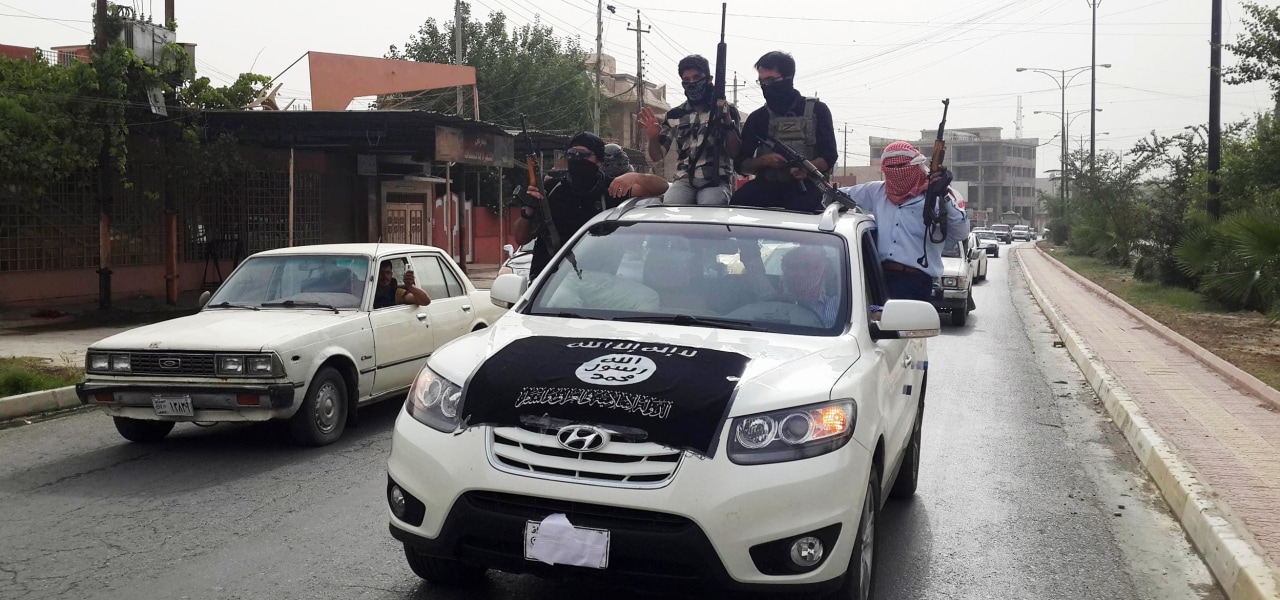
The recent military success of ISIS in Iraq is building a terrorist “brand” that is increasing the group’s following among jihadis worldwide, putting the group in a position to potentially eclipse the group that once nurtured it, Osama bin Laden’s al Qaeda, U.S. officials tell NBC News.
The battlefield accomplishments of the Islamic State of Iraq and al-Sham (ISIS) are likewise pushing the group’s low-profile leader, Abu Bakr al-Baghdadi, into prominence in the world of extreme Islam, and could help him secure the leadership mantle left vacant by the death of bin Laden, according to the officials, who briefed reporters Tuesday on condition of anonymity.
That would be an ironic twist, as al-Baghdadi has long been at odds with Ayman al-Zawahri, who took over as al Qaeda’s leader when bin Laden was killed in 2011. At the center of the dispute — a “schism” in the words of one senior U.S. counterterrorism official — is a serious disagreement over the tactics of terrorism and what appears to be a high level of distrust between the two terrorist leaders.
U.S. officials do not for now consider ISIS more dangerous than al Qaeda, noting that the latter continues to focus on international operations while the former is strictly regional.
Al-Baghdadi, whose real name is not known, had been largely a cipher prior to ISIS’s recent emergence as a military force to be reckoned with. He does not issue videos on a regular basis like bin Laden did. There are only two pictures of him circulating on the Internet. And charisma is not considered to be part of his kit bag.
Sign up for breaking news alerts from NBC News
But the U.S. officials say there is little doubt that al-Baghdadi has ambitious goals, aiming to install himself as the leader, or "caliph," of a vast Islamic state governed by sharia law and stretching from the middle of Iraq into central Syria.
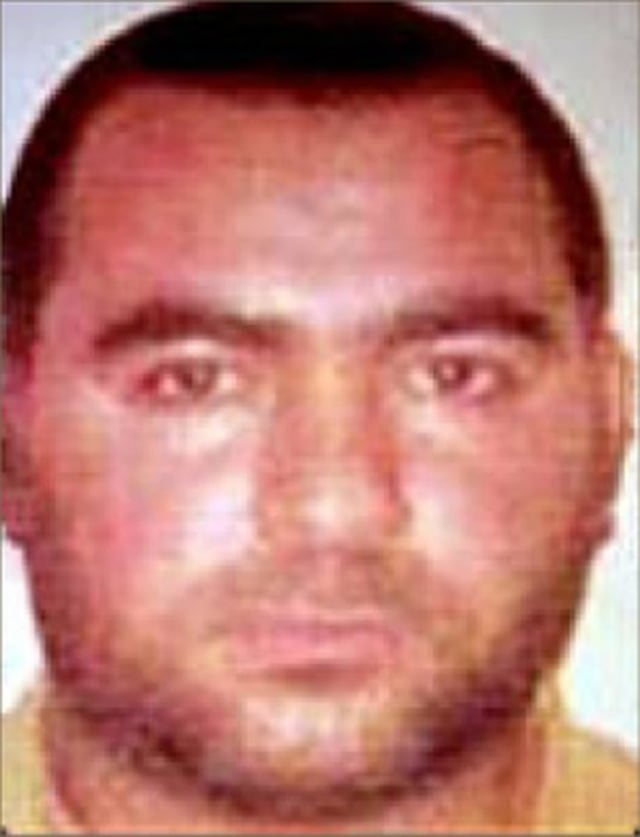
Abu Bakr al-Baghdadi, commander of the Islamic State in Iraq and Syria, in a U.S. State Department wanted poster.
In doing so, he is emulating bin Laden, the man to whom he swore “bayat” — personal loyalty — in 2006 following an application process that included tests of ideology, battlefield experience, etc.
But while bin Laden launched the 9-11 attacks and helped the Taliban take over Afghanistan, he never controlled a vast territory in the heart of the Middle East as al-Baghdadi now does. So he never came close to realizing his dream of establishing a caliphate — or Islamic state — governed by sharia.
If ISIS can hold or expand the territory it now controls in Iraq and Syria, al-Baghdadi may be able to supersede his master.
He has done so without any help from Zawahiri, whom he despises and who detests him in return.
"He is headstrong, having bucked al Qaeda leader Zawahri’s commands on multiple occasions to the point of schism," said the senior U.S. counterterrorism official. "It is difficult to see al-Baghdadi returning to the al Qaeda fold any time soon, especially with the ISIS brand gaining increasing credibility as an alternative to al Qaeda among violent jihadists worldwide."
In February, relations between the two became so acrimonious that Zawahri expelled ISIS and its leader from al Qaeda. The language was bureaucratic.
"Al Qaeda declares that it has no links to the ISIS group," Zawahri said in a posting on jihadist websites. "We weren't informed about its creation, nor counseled. Nor were we satisfied with it; rather we ordered it to stop. ISIS isn't a branch of al Qaeda and we have no organizational relationship with it. Nor is al Qaeda responsible for its actions and behavior."
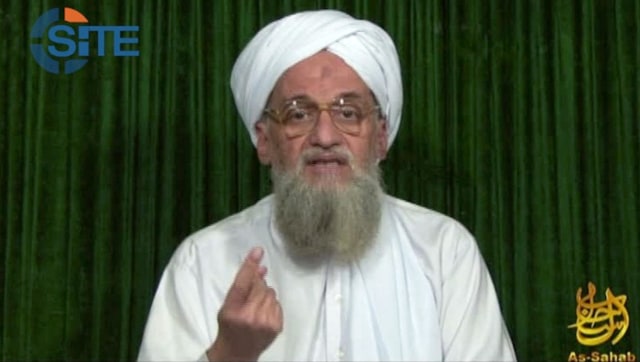
Al Qaeda leader Ayman al-Zawahri, in a video frame grab, provided by the SITE Intel Group on Feb 12, 2012
The latter was a reference to al-Baghdadi’s embrace of bloody tactics — including attacks that aim to kill innocent Muslims in great numbers — that al Qaeda considers counterproductive in the context of a greater war against the “infidels” of the West.
The dispute hasn’t only been fought on jihadi forums, however. "ISIS has been violently clashing with al-Nusra (an al Qaeda affiliate fighting in Syria) in recent months," said Evan Kohlmann, an NBC News counterterrorism analyst. "It's making it increasingly uncomfortable for them (ISIS) in many parts of Syria."
The decision to expel ISIS came after a number of disagreements over strategy in Syria, where Zawahri preferred al-Nusra, which is more Syria-focused and less about a caliphate. Zawahri also didn't like ISIS's arrogance, its failure to engage in “consultation” and lack of “teamwork,” according to the posting.
Zawahri has a history of disagreement with ISIS and its predecessor, al Qaeda in Iraq (AQI).
He disapproved of wanton massacres of Shiite Muslims carried out by the group in Iraq, calling it a "deviation" from its stated goal.
In a 2005 letter from Zawahri to AQI's then leader, Abu Musab Zarqawi, the former asked, “Can the mujahadeen kill all the Shia in Iraq? Has any Islamic state in history ever tried that?” The letter was later found by U.S. intelligence.
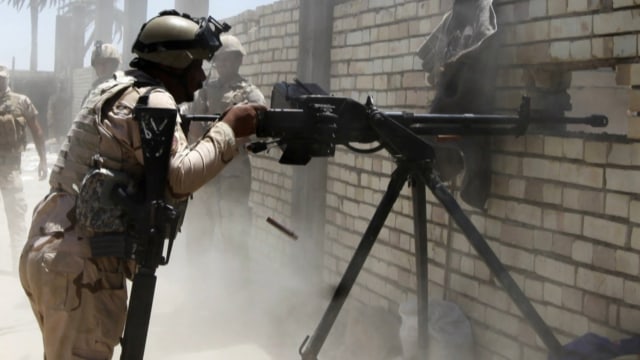
Another point of dispute, says the U.S. counterterrorism official, is the manner in which ISIS raises funds, under al-Baghdadi's orders.
"He has endorsed the use of brutal methods to terrorize civilian populations under ISIS control and employs coercive methods that would be familiar to an organized crime group to secure needed financing," the official said.
Specifically, added a second senior U.S. intelligence official, the group preys on fellow Muslims. ISIS gets some money from foreign donors, but it "pales to what they get from extortion, robbery, kidnapping," the official said. "They require drivers to pay 'road taxes' in territories it controls." The total take is several million dollars a month, added the official.
Still, ISIS has shown its ability to gain control over vast stretches of Iraq, where its estimated 3,000 to 5,000 ISIS fighters are vastly outnumbered by the Iraqi security services, which had 930,000 troops in uniform as of late 2011, 70 percent of which were in the Iraqi army.
Follow NBC News Investigations on Twitter and Facebook.
"Al-Baghdadi is a ruthless, resilient and ambitious terrorist leader," said the counterterrorism official, conceding, "Unfortunately, he has shown he has a knack for tactical operations and, it seems, military strategy.
But it is uncertain whether those skills will translate to administration.
"The one saving grace is that every affiliate has failed at running territory," added another U.S. intelligence official. "They are universally hated by the local populace in territory they seize. They alienate local populations every time."
First published June 25th 2014, 3:54 am
ROBERT WINDREM
Source of Article
The recent military success of ISIS in Iraq is building a terrorist “brand” that is increasing the group’s following among jihadis worldwide, putting the group in a position to potentially eclipse the group that once nurtured it, Osama bin Laden’s al Qaeda, U.S. officials tell NBC News.
The battlefield accomplishments of the Islamic State of Iraq and al-Sham (ISIS) are likewise pushing the group’s low-profile leader, Abu Bakr al-Baghdadi, into prominence in the world of extreme Islam, and could help him secure the leadership mantle left vacant by the death of bin Laden, according to the officials, who briefed reporters Tuesday on condition of anonymity.
That would be an ironic twist, as al-Baghdadi has long been at odds with Ayman al-Zawahri, who took over as al Qaeda’s leader when bin Laden was killed in 2011. At the center of the dispute — a “schism” in the words of one senior U.S. counterterrorism official — is a serious disagreement over the tactics of terrorism and what appears to be a high level of distrust between the two terrorist leaders.
U.S. officials do not for now consider ISIS more dangerous than al Qaeda, noting that the latter continues to focus on international operations while the former is strictly regional.
Al-Baghdadi, whose real name is not known, had been largely a cipher prior to ISIS’s recent emergence as a military force to be reckoned with. He does not issue videos on a regular basis like bin Laden did. There are only two pictures of him circulating on the Internet. And charisma is not considered to be part of his kit bag.
Sign up for breaking news alerts from NBC News
But the U.S. officials say there is little doubt that al-Baghdadi has ambitious goals, aiming to install himself as the leader, or "caliph," of a vast Islamic state governed by sharia law and stretching from the middle of Iraq into central Syria.
Abu Bakr al-Baghdadi, commander of the Islamic State in Iraq and Syria, in a U.S. State Department wanted poster.
In doing so, he is emulating bin Laden, the man to whom he swore “bayat” — personal loyalty — in 2006 following an application process that included tests of ideology, battlefield experience, etc.
But while bin Laden launched the 9-11 attacks and helped the Taliban take over Afghanistan, he never controlled a vast territory in the heart of the Middle East as al-Baghdadi now does. So he never came close to realizing his dream of establishing a caliphate — or Islamic state — governed by sharia.
If ISIS can hold or expand the territory it now controls in Iraq and Syria, al-Baghdadi may be able to supersede his master.
He has done so without any help from Zawahiri, whom he despises and who detests him in return.
"He is headstrong, having bucked al Qaeda leader Zawahri’s commands on multiple occasions to the point of schism," said the senior U.S. counterterrorism official. "It is difficult to see al-Baghdadi returning to the al Qaeda fold any time soon, especially with the ISIS brand gaining increasing credibility as an alternative to al Qaeda among violent jihadists worldwide."
In February, relations between the two became so acrimonious that Zawahri expelled ISIS and its leader from al Qaeda. The language was bureaucratic.
"Al Qaeda declares that it has no links to the ISIS group," Zawahri said in a posting on jihadist websites. "We weren't informed about its creation, nor counseled. Nor were we satisfied with it; rather we ordered it to stop. ISIS isn't a branch of al Qaeda and we have no organizational relationship with it. Nor is al Qaeda responsible for its actions and behavior."
Al Qaeda leader Ayman al-Zawahri, in a video frame grab, provided by the SITE Intel Group on Feb 12, 2012
The latter was a reference to al-Baghdadi’s embrace of bloody tactics — including attacks that aim to kill innocent Muslims in great numbers — that al Qaeda considers counterproductive in the context of a greater war against the “infidels” of the West.
The dispute hasn’t only been fought on jihadi forums, however. "ISIS has been violently clashing with al-Nusra (an al Qaeda affiliate fighting in Syria) in recent months," said Evan Kohlmann, an NBC News counterterrorism analyst. "It's making it increasingly uncomfortable for them (ISIS) in many parts of Syria."
The decision to expel ISIS came after a number of disagreements over strategy in Syria, where Zawahri preferred al-Nusra, which is more Syria-focused and less about a caliphate. Zawahri also didn't like ISIS's arrogance, its failure to engage in “consultation” and lack of “teamwork,” according to the posting.
Zawahri has a history of disagreement with ISIS and its predecessor, al Qaeda in Iraq (AQI).
He disapproved of wanton massacres of Shiite Muslims carried out by the group in Iraq, calling it a "deviation" from its stated goal.
In a 2005 letter from Zawahri to AQI's then leader, Abu Musab Zarqawi, the former asked, “Can the mujahadeen kill all the Shia in Iraq? Has any Islamic state in history ever tried that?” The letter was later found by U.S. intelligence.
Another point of dispute, says the U.S. counterterrorism official, is the manner in which ISIS raises funds, under al-Baghdadi's orders.
"He has endorsed the use of brutal methods to terrorize civilian populations under ISIS control and employs coercive methods that would be familiar to an organized crime group to secure needed financing," the official said.
Specifically, added a second senior U.S. intelligence official, the group preys on fellow Muslims. ISIS gets some money from foreign donors, but it "pales to what they get from extortion, robbery, kidnapping," the official said. "They require drivers to pay 'road taxes' in territories it controls." The total take is several million dollars a month, added the official.
Still, ISIS has shown its ability to gain control over vast stretches of Iraq, where its estimated 3,000 to 5,000 ISIS fighters are vastly outnumbered by the Iraqi security services, which had 930,000 troops in uniform as of late 2011, 70 percent of which were in the Iraqi army.
Follow NBC News Investigations on Twitter and Facebook.
"Al-Baghdadi is a ruthless, resilient and ambitious terrorist leader," said the counterterrorism official, conceding, "Unfortunately, he has shown he has a knack for tactical operations and, it seems, military strategy.
But it is uncertain whether those skills will translate to administration.
"The one saving grace is that every affiliate has failed at running territory," added another U.S. intelligence official. "They are universally hated by the local populace in territory they seize. They alienate local populations every time."
First published June 25th 2014, 3:54 am
ROBERT WINDREM
Re: The King of The "North" Is Coming!
Isis air strikes: Obama's plan condemned by Syria, Russia and Iran
Ian Black, Middle East editor, and Dan Roberts in Washington
theguardian.com, Friday 12 September 2014 02.42 EDT
Source of Article
Claims that strikes would violate sovereignty, as Syrian rebels welcome move and other Arab states offer 'appropriate' support
• A tale of two speeches: emboldened Obama moves from dove to hawk
• Illegal? Irrational? Irrelevant? Obama's Isis address falls down on every front
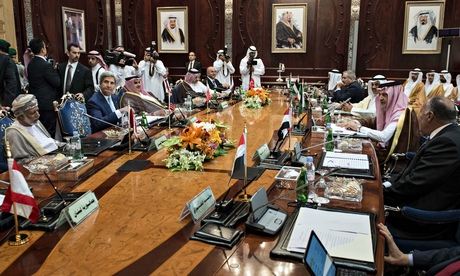
The Syrian government and its close allies in Moscow and Tehran warned Barack Obama that an offensive against Islamic State (Isis) within Syria would violate international law yesterday, hours after the US president announced that he was authorising an open-ended campaign of air strikes against militants on both sides of the border with Iraq.
Syrian opposition groups welcomed Obama's announcement and called for heavy weapons to fight the "terror" of Isis and Bashar al-Assad. Saudi Arabia and nine other Arab states pledged to back the US plan "as appropriate".
Hadi al-Bahra, head of the western-backed Syrian National Coalition, said the group "stands ready and willing to partner with the international community not only to defeat Isis but also rid the Syrian people of the tyranny of the Assad regime". In Reyhanli, on the Turkish-Syrian border, a spokesman for the Free Syrian Army (FSA) said that moderate anti-Assad forces urgently needed anti-tank and anti-aircraft missiles.
But long-standing international divisions over Syria were starkly highlighed in the hours after the speech. Iran's foreign ministry said that "the so-called international coalition to fight the Isil [Islamic State] group ... is shrouded in serious ambiguities and there are severe misgivings about its determination to sincerely fight the root causes of terrorism."
Russia said it would not support any military action without a UN resolution authorising it. "The US president has spoken directly about the possibility of strikes by the US armed forces against Isil positions in Syria without the consent of the legitimate government," said a spokesman. "This step, in the absence of a UN security council decision, would be an act of aggression, a gross violation of international law." China said that the world should fight terror but that national sovereignty must be respected.
In Damascus, the Assad government warned against US raids. "Any action of any kind without the consent of the Syrian government would be an attack on Syria," said the national reconciliation minister, Ali Haidar. Analysts believe, however, that Assad would be likely to ignore strikes on Isis targets – and even seek to quietly cooperate with western efforts.
In a meeting with Staffan de Mistura, the new UN envoy for Syria, Assad stressed his commitment to fight "terrorism" but he made no mention of the US president's speech on Wednesday night.
"As long as air strikes only hit Isis they will be condemned as a violation of international law but won't be dealt with as aggression that requires retaliation," Jihad Makdissi, a former Syrian diplomat, told the Guardian.
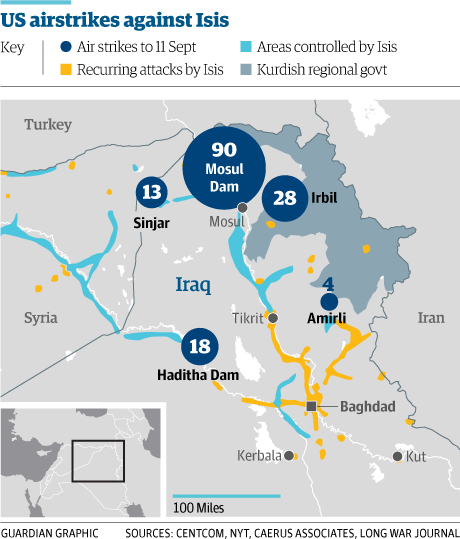
Obama used a long-heralded address on the eve of the 13th anniversary of the 9/11 attacks to lay out his response to the appearance of an aggressive jihadi insurgency in the heart of the Arab world. US polls show growing support for military action since Isis fighters captured large areas of northern Iraq and eastern Syria and beheaded two American citizens in the past month.
He compared the campaign to those waged against al-Qaida in Yemen and Somalia, where US drones, cruise missiles and special operations raids have battered local affiliates without, however, notably improving the stability of either country or dealing decisive blows.
Obama's new strategy won swift if vague support from America's Arab allies, with Saudi Arabia agreeing to train Syrian rebel fighters. John Kerry, the US secretary state, held talks in the port city of Jeddah with ministers from Iraq, Jordan, Lebanon, Egypt and six Gulf states. After the meeting, participants said they had agreed "as appropriate" to "many aspects" of the military campaign against Isis, to stop the flow of funds and fighters and help rebuild communities "brutalised" by the group. Support was also expressed for the new, more inclusive Baghdad government – seen as vital to persuade Iraq's disaffected Sunnis not to support Isis. MPs in Jordan, warned, however, that they would not tolerate any participation in US action.
"We welcome this new strategy," said Hoshyar Zebari, a Kurdish politician and one of Iraq's newly appointed deputy prime ministers. "There is an urgent need for action. People cannot sit on the fence. This is a mortal threat to everybody."
There was confusion over Britain's role after Philip Hammond, the foreign secretary, said the UK would not take part in air strikes. But Downing Street quickly announced that UK participation had not been ruled out. Germany said it would not participate. Both countries have sent weapons and ammuniction to the Iraqi Kurds – part of the overall anti-Isis strategy.
The Pentagon is currently working on identifying suitable targets in Syria, according to White House officials. The US will also deploy a further 475 troops to Iraq, where they are expected to help identify targets.
US officials said that Kerry would be seeking to pressure Kuwait and Qatar to stop their citizens financing al-Qaida and Isis. The Saudis, stung by accusations of support for the jihadis, have already worked to crack down on funding and announced the arrest of scores of alleged terrorist sympathisers in recent weeks.
Obama said the air strikes were a necessary counter-terrorism measure to prevent the group from becoming a future threat to the US and therefore did not require fresh congressional approval. But he is expected to receive overwhelming congressional support for separate authorisation to provide military support to rival Syrian rebels like the FSA, a vote that some Republicans fear could help boost Democratic chances in this November's midterm elections by providing political support for his tough new foreign policy.
End of article.
Re: The King of The "North" Is Coming!
The anatomy of ISIS: How the 'Islamic State' is run, from oil to beheadings
By Nick Thompson and Atika Shubert, CNN
updated 8:01 AM EDT, Thu September 18, 2014
Source of Article
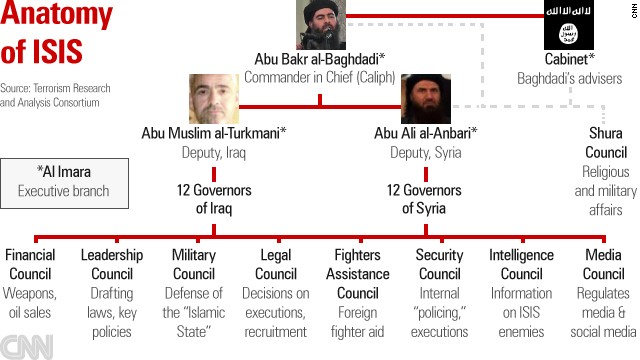
ISIS is putting in place structures to rule the territories the group conquers. (Source: TRAC)
(CNN) -- Put yourself in the shoes (and sixth-century black robes) of ISIS' Abu Bakr al-Baghdadi, the mysterious boss of the terror group that is striking fear into the hearts of leaders around the world.
In the past couple of years you've managed to avoid drone attacks and survive civil wars, unify militant groups in two different countries under your banner, raise an army of jihadis from across the globe, and seize a chunk of land stretching from northern Syria to central Iraq.
Your newly-declared "Islamic State" is the size of Pennsylvania, so how do you govern it? You compartmentalize.
New data from the Terrorism Research and Analysis Consortium (TRAC) has revealed that ISIS is putting governing structures in place to rule the territories the group conquers once the dust settles on the battlefield.
The research shows how ISIS has gone from being a purely military force to building a system that can provide basic services, such as making sure that gas and food are available, to its new citizens.
From the cabinet and the governors to the financial and legislative bodies, ISIS' bureaucratic hierarchy looks a lot like those of some of the Western countries whose values it rejects -- if you take away the democracy and add in a council to consider who should be beheaded.
Baghdadi, his Cabinet advisers and his two key deputies comprise the executive branch of the government, known as "Al Imara."
The two deputies -- Abu Ali al-Anbari and Abu Muslim al-Turkmani, veteran Iraqi military officials who served under Saddam Hussein -- oversee Syria and Iraq, respectively.
ISIS has probably split the governance of the "Islamic State" into Syrian and Iraqi branches simply to make it easier to run, according to Jasmine Opperman, TRAC's Southern Africa Director.
"They see the caliphate as one state, yet there are two different governments," Opperman told CNN. "I believe this split is purely administrative at this time. They don't want to be seen as downplaying the caliphate, but to make it easier to govern they were forced to make a separation between Syria and Iraq."
The two deputies deliver orders to the governors in charge of the various sub-states in Syria and Iraq under ISIS control, who then instruct local councils on how to implement the executive branch's decrees on everything from media relations and recruiting to policing and financial matters.
The Shura council -- which reports directly to the executive branch -- is the caliphate's religious monitor, appointed to make sure that all the local councils and governors are sticking to ISIS' version of Islamic law.
The recent murders of Western hostages James Foley, Steven Sotloff, and David Haines would have fallen under the Shura council's purview, according to Opperman.
"Let's say a significant execution is going to take place, something that will get ISIS on the front page of the newspaper," Opperman said. "It cannot be done without Shura council approval."
The Shura council also has the power to censure the leadership for running afoul of its interpretation of Sharia law, according to Opperman.
"The Shura council has the right to tell Baghdadi to go if he's not adhering to ISIS' religious standards," she told CNN. "It would most probably never happen, but the fact that it's possible indicates the council's prominence."
Baghdadi -- who was once imprisoned by U.S. forces in Iraq -- seems to have incorporated the American military's own counter-insurgency mantra of "Clear and Hold" to win territory, establish control over the area, then get the locals to help govern it.
As time goes on, ISIS is evolving into a government whose political decision-making cannot be separated from its military capabilities, according to Opperman.
"It's two sides of the same coin," she said. "We've seen the military side, with the war cabinet that directs brigades. But now on the other side we're seeing how ISIS wants to govern. The two processes inform one another."
End of article
***
By Nick Thompson and Atika Shubert, CNN
updated 8:01 AM EDT, Thu September 18, 2014
Source of Article
ISIS is putting in place structures to rule the territories the group conquers. (Source: TRAC)
(CNN) -- Put yourself in the shoes (and sixth-century black robes) of ISIS' Abu Bakr al-Baghdadi, the mysterious boss of the terror group that is striking fear into the hearts of leaders around the world.
In the past couple of years you've managed to avoid drone attacks and survive civil wars, unify militant groups in two different countries under your banner, raise an army of jihadis from across the globe, and seize a chunk of land stretching from northern Syria to central Iraq.
Your newly-declared "Islamic State" is the size of Pennsylvania, so how do you govern it? You compartmentalize.
New data from the Terrorism Research and Analysis Consortium (TRAC) has revealed that ISIS is putting governing structures in place to rule the territories the group conquers once the dust settles on the battlefield.
The research shows how ISIS has gone from being a purely military force to building a system that can provide basic services, such as making sure that gas and food are available, to its new citizens.
From the cabinet and the governors to the financial and legislative bodies, ISIS' bureaucratic hierarchy looks a lot like those of some of the Western countries whose values it rejects -- if you take away the democracy and add in a council to consider who should be beheaded.
Baghdadi, his Cabinet advisers and his two key deputies comprise the executive branch of the government, known as "Al Imara."
The two deputies -- Abu Ali al-Anbari and Abu Muslim al-Turkmani, veteran Iraqi military officials who served under Saddam Hussein -- oversee Syria and Iraq, respectively.
ISIS has probably split the governance of the "Islamic State" into Syrian and Iraqi branches simply to make it easier to run, according to Jasmine Opperman, TRAC's Southern Africa Director.
"They see the caliphate as one state, yet there are two different governments," Opperman told CNN. "I believe this split is purely administrative at this time. They don't want to be seen as downplaying the caliphate, but to make it easier to govern they were forced to make a separation between Syria and Iraq."
The two deputies deliver orders to the governors in charge of the various sub-states in Syria and Iraq under ISIS control, who then instruct local councils on how to implement the executive branch's decrees on everything from media relations and recruiting to policing and financial matters.
The Shura council -- which reports directly to the executive branch -- is the caliphate's religious monitor, appointed to make sure that all the local councils and governors are sticking to ISIS' version of Islamic law.
The recent murders of Western hostages James Foley, Steven Sotloff, and David Haines would have fallen under the Shura council's purview, according to Opperman.
"Let's say a significant execution is going to take place, something that will get ISIS on the front page of the newspaper," Opperman said. "It cannot be done without Shura council approval."
The Shura council also has the power to censure the leadership for running afoul of its interpretation of Sharia law, according to Opperman.
"The Shura council has the right to tell Baghdadi to go if he's not adhering to ISIS' religious standards," she told CNN. "It would most probably never happen, but the fact that it's possible indicates the council's prominence."
Baghdadi -- who was once imprisoned by U.S. forces in Iraq -- seems to have incorporated the American military's own counter-insurgency mantra of "Clear and Hold" to win territory, establish control over the area, then get the locals to help govern it.
As time goes on, ISIS is evolving into a government whose political decision-making cannot be separated from its military capabilities, according to Opperman.
"It's two sides of the same coin," she said. "We've seen the military side, with the war cabinet that directs brigades. But now on the other side we're seeing how ISIS wants to govern. The two processes inform one another."
End of article
***